Objects & Beliefs
A Faience Ring Carries a Divine Name in a Small Space
Explore a Walters Art Museum finger ring through its recorded material, date and named inscription while keeping interpretation tied to the catalogue.

Explore what objects can tell us about ancient lives and beliefs, with room for uncertainty.
Explore a Walters Art Museum finger ring through its recorded material, date and named inscription while keeping interpretation tied to the catalogue.
Read a small Egyptian faience bowl through its recorded dimensions and decoration before making assumptions from an enlarged online photograph.
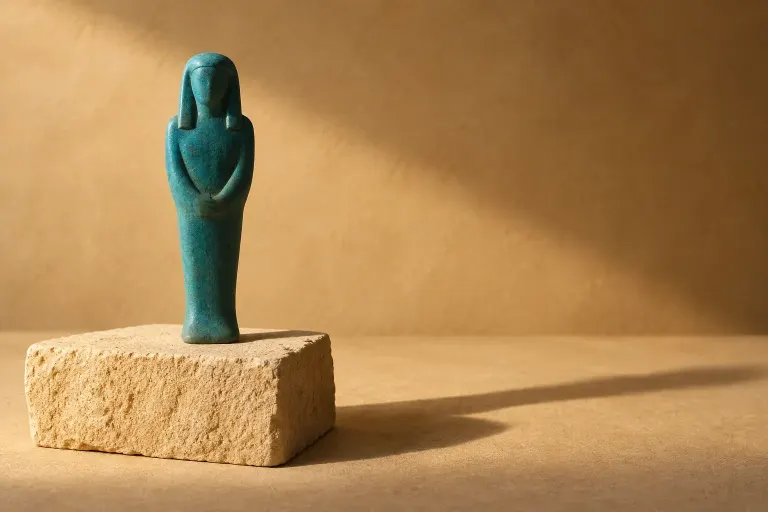
Read one canopic jar record through the person named in its inscription, while keeping the object number, date range and related reference distinct.
Explore a Roman-period sistrum through its surviving wires and missing sound elements, while keeping the museum’s alternative interpretations visible.
Meketre’s model granary depicts storage alongside measuring and accounting. Look at how its figures divide the work before imagining a whole economy.
A canopic coffinette from Tutankhamun’s equipment shows why a small object should be understood alongside the larger arrangement that held it.
An ivory spoon in The Met shows how a familiar catalogue label can coexist with uncertainty about an ancient object’s precise use.
A pottery canopic jar with a missing lid shows why condition notes matter when studying Egyptian objects through museum photographs.