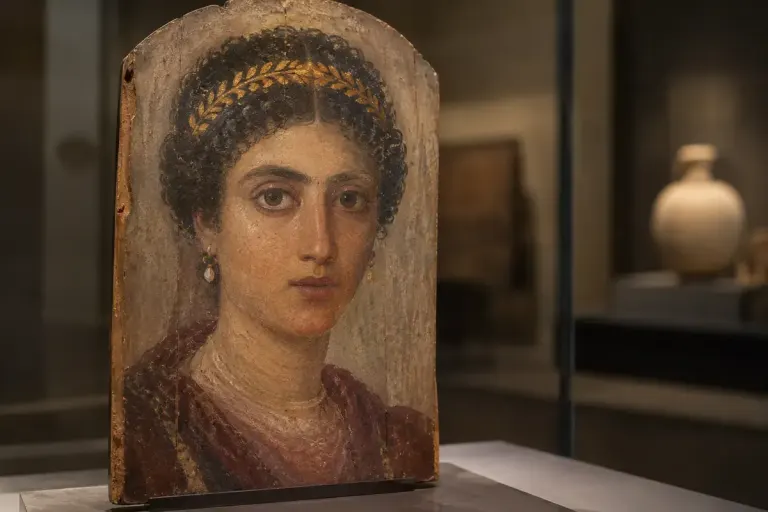
Materials & Making
A Mummy Portrait Records a Painted Face on a Separate Support
Read an Egyptian mummy portrait through its painted support, museum record and surviving relationship to the burial assemblage.

Look closely at the substances, surfaces and craft behind ancient objects.
Read an Egyptian mummy portrait through its painted support, museum record and surviving relationship to the burial assemblage.
A small container can reward attention to movement as much as decoration. The Met’s ivory cosmetic box 16.10.425 has a lid designed to swivel around a peg…
A patterned surface can suggest precious inlay while being made by a different process. The cosmetic box from Sennedjem’s tomb offers a clear reason to read…
A toiletry set can include an object concerned with maintaining another tool rather than directly applying a cosmetic. The Met’s whetstone 26.7.837d is a…
A fishing scene can suggest an entire working landscape. A surviving hook asks us to change scale and examine one small component whose own record may be…
A brick mould is a tool for giving material a repeatable form. The Met’s wooden example, object 25.3.108, also has a recorded archaeological setting: a…
The Met’s arched harp, object 25.3.306a, b, preserves a wooden form whose musical operation involved other materials. The museum explains that its sound box…
A small surviving support can tempt us to imagine a complete piece of furniture. The Met’s ivory furniture leg, object 26.7.1283, is only six centimetres…