
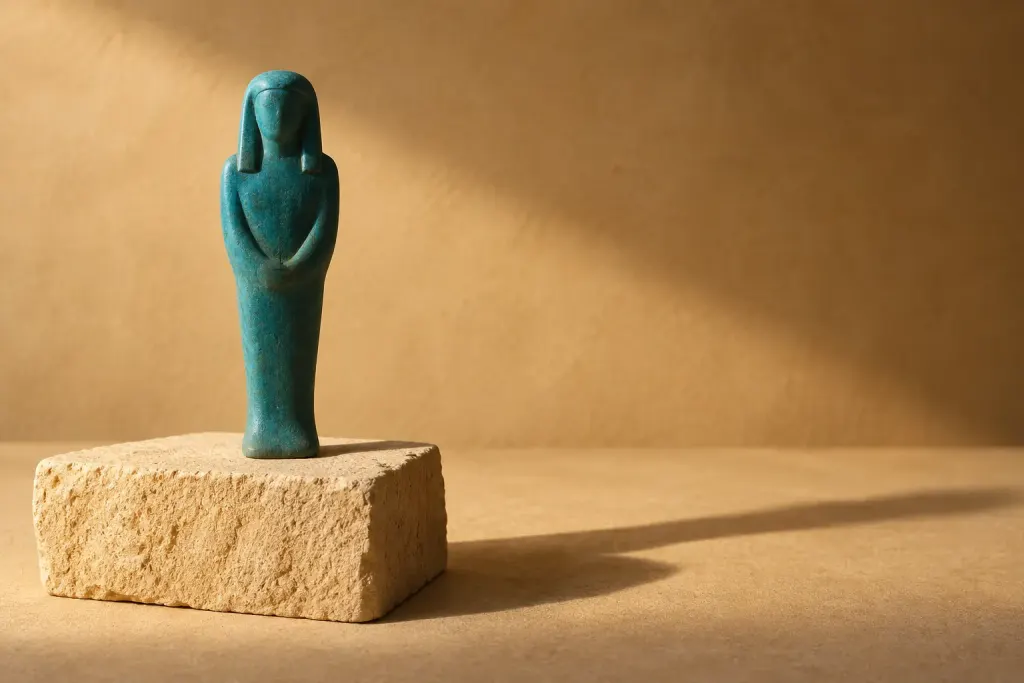
A miniature coffin is easy to read as a reduced version of a familiar shape. But its role depends on the larger arrangement around it. A canopic coffinette offers a good reason to ask where an object fitted, not only what it resembles.
Read the nested arrangement
The Grand Egyptian Museum’s record for GEM 471 describes gold coffinettes with coloured inlays that held Tutankhamun’s embalmed organs. They were wrapped in linen and placed within compartments of a canopic chest.
The individual object therefore belongs to a sequence of containers and protective imagery. Studying it alone leaves part of that relationship outside the frame.
Draw relationships rather than a reconstruction
In your notebook, use labelled boxes to show “coffinette within chest”. Add only the relationships stated in the source. You do not need to invent an exact three-dimensional arrangement or reproduce inscriptions you cannot read.
Keep material, function and imagery as separate headings. Gold describes one material; it does not explain the whole purpose. A depicted figure introduces another question rather than replacing the container’s context.
Return to the specific record
Retain the museum identifier when comparing related objects. General accounts of canopic equipment should not erase differences between individual examples.
This page uses a conceptual illustration. For the real object, follow the museum record. Compare it with a pottery jar whose lid is missing to see why the surviving evidence matters.