
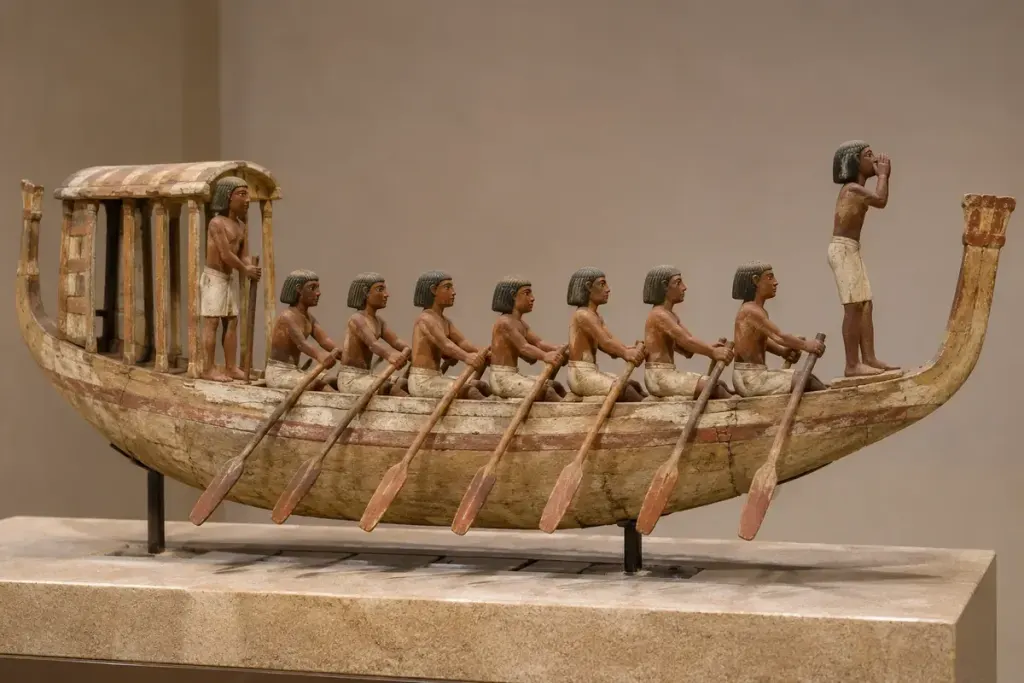
A model boat can draw attention to its hull first. In the travelling boat from Meketre’s tomb, the arrangement of people offers another route into the object: rowers, a helmsman, a figure at the bow and passengers associated with music and status.
The Metropolitan Museum of Art identifies Travelling Boat being Rowed, accession 20.3.1, as a Middle Kingdom model dating to approximately 1981–1975 BCE. Its listed materials include wood, paint, gesso, linen twine and linen fabric. The catalogue interprets it as a boat travelling downstream, with the mast absent and rowing equipment in use.
The museum identifies the figure in the bow with measuring the channel’s depth and the stern figure with steering. Meketre sits near his cabin with musical performers nearby. These are curatorial identifications attached to a particular surviving object, not names we can establish simply by looking at any small painted figure.
Make a position map before a story
Using the museum’s images, sketch a long outline and mark three areas: bow, middle and stern. Add only the roles that the record supports. A rough map can reveal how work, movement and the prominent passenger are distributed without needing a detailed drawing of every figure.
Then separate what the image shows from what the catalogue explains. “A standing figure occupies the bow” is an observation. “The figure is preparing to sound the depth” uses the museum’s interpretation. Keeping both lines makes the note easier to check later.
Read the dimensions with their boundaries
The catalogue’s length includes the steering oar, while its width includes the oars. Those qualifications matter when imagining the model’s physical presence. Do not quietly treat the overall dimensions as measurements of the hull alone.
The model also selects a moment and an arrangement. It cannot show every activity that occurred aboard a working boat, and it is not a complete construction plan. Ask which tasks and relationships have been made visible, then leave unrepresented details open.
The illustration accompanying this article is AI-generated and is not a photograph or measured reconstruction of accession 20.3.1. For close observation, use the museum’s own object images and catalogue. A good reading of the model starts with that distinction: one small vessel can carry a rich interpretation without becoming evidence for every part of ancient river travel.