
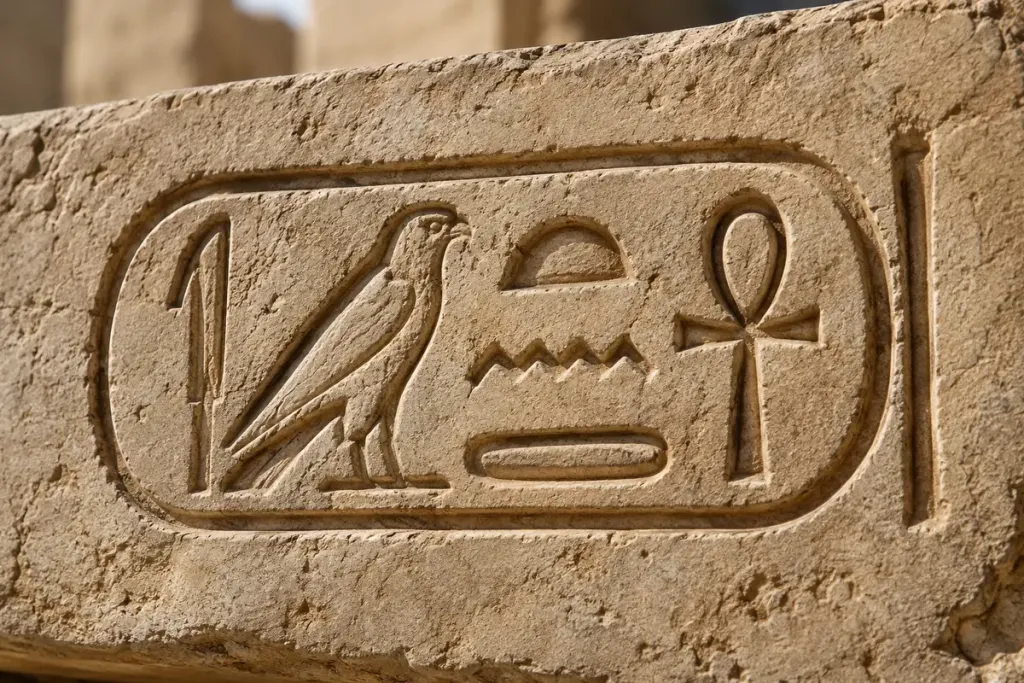
An oval enclosure around hieroglyphs draws the eye before the signs inside it become readable. That border is useful evidence, but recognising a cartouche is not the same as translating the name it contains.
Notice the boundary first
The Global Egyptian Museum’s cartouche explanation connects the enclosure with royal names. Treat the frame and the signs as two observations: the frame helps identify the kind of inscription, while the signs require their own reading.
On a museum object, copy the supplied identification and accession number. If the catalogue offers a transliteration or translation, keep it separate from your sketch. Do not substitute a familiar royal name simply because the outline looks similar to an image you remember.
Keep the object around the writing
A cartouche on a small amulet, a wall or a later reproduction appears in different contexts. Record the material, approximate scale and location of the inscription. A close-up of the oval cannot establish the date of the whole object by itself.
For an introductory exercise, compare two catalogue images whose names are already identified. Look for repeated and differing signs without claiming to decipher a new inscription. If a sign is damaged or cropped, mark that limit. Learning to preserve uncertainty is part of reading ancient writing: a clear frame may surround a text whose surviving details remain incomplete.
AI-generated editorial illustration; not a documentary photograph.